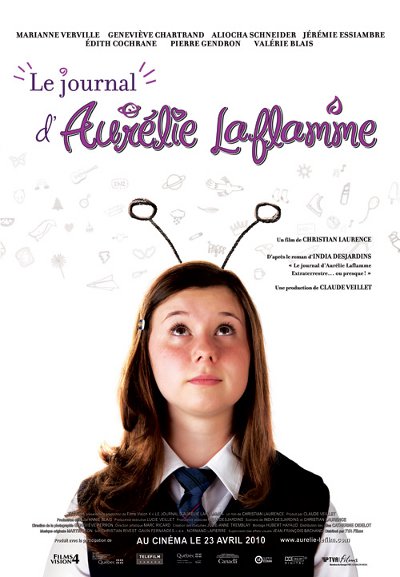
Journal d’Aurélie Laflamme, Le – Film de Christian Laurence

Le Journal d’Aurélie Laflamme est une comédie pour adolescents dont le personnage principal est tiré de la populaire série de livres écrits par l’auteure India Desjardins.

Le journal d’Aurélie Laflamme de Christian Laurence

Le journal d’Aurélie Laflamme de Christian Laurence

Le Journal d’Aurélie Laflamme est une comédie pour adolescents dont le personnage principal est tiré de la populaire série de livres écrits par l’auteure India Desjardins. Ce film est basé sur le premier tome de la série « Aurélie Laflamme, Extraterrestre ou presque ». Le réalisateur Christian Laurence vient du domaine de la télévision et signe ici son premier long-métrage de cinéma.

Comme on pouvait s’en douter d’après les succès obtenus par les livres, Le Journal d’Aurélie Laflamme fut reçu chaleureusement par le jeune public québécois qui en fit l’un des succès au box office de 2010. Au niveau international, le film de Christian Laurence eut droit à quelques sélections dans les festivals francophones, sans toutefois se démarquer outre mesure.

Un second film tiré des aventures d’Aurélie Laflamme a été produit par la suite.

Résumé

Aurélie est une adolescente de 14 ans, un peu perdue et donc en quête de solutions. Entre les habitudes de sa mère sédentaire et les chicanes avec sa meilleure amie, elle rêve à son premier french kiss ! Mais au fond, Aurélie se sent bien seule dans l'’univers, surtout depuis la mort de son père, il ya 5 ans.

Et si son père était simplement un extraterrestre, ayant quitté la Terre pour rejoindre sa planète? Génétique oblige, Aurélie serait elle-même une extraterrestre! Ceci expliquerait bien des choses. Par exemple, pourquoi elle se sent si différente des autres (surtout de sa mère), pourquoi elle n'’est pas capable d’'enligner deux mots sans faire une gaffe, et surtout pourquoi les garçons lui tapent vraiment sur les nerfs.

Synopsis officiel

Distribution

Marianne Verville (Aurélie Laflamme) ; Geneviève Chartrand (Kat) ; Aliocha Schneider (Nicolas) ; Jérémie Essiambre (Truch) ; Edith Cochrane (mère d’Aurélie) ; Pierre Gendron (Denis Beaulieu) ; Valérie Blais (Marie-Claude) ; Sylvie Potvin (Soeur Rose)

Fiche technique

Genre: Comédie dramatique - Origine: Québec, 2009 - Sortie en salles: 23 avril 2010 dans 83 salles au Québec - Durée: 1h48 - Classement: Général - Tournage: septembre-octobre 2009 - Budget approximatif: 4,1 M$

Réalisation : Christian Laurence - Scénario : Christian Laurence et India Desjardins, d'après le roman éponyme d'India Desjardins - Production : Claude Veillet et Lucie Veillet - Société de production : Films Vision 4 - Distribution : TVA Films

Équipe technique - Costumes : Julie-Anne Tremblay - Direction artistique : Marc Ricard - Montage : Hubert Hayaud - Musique : Martin Léon - Photographie : Geneviève Perron
If you arrived here looking for explicit images or videos of a person named “NiksIndian,” exercise caution. Verify sources. Instead, use this article as a gateway to celebrate authentic Nargis-inspired beauty.

The fascination with doppelgängers is deeply rooted in human psychology. The "NiksIndian 22.03.01 Nargis Look Alike Beautiful" phenomenon is a modern example of this age-old curiosity. The search for, and delight in finding, individuals who look like other people, especially celebrities, is a global obsession, driving countless articles and social media conversations. The idea that another person can physically mirror someone else's appearance is a source of constant wonder. It challenges our sense of uniqueness and highlights the fascinating, sometimes repetitive, patterns of human genetics.

When modern content creators search for a “Nargis look-alike beautiful,” they are searching for , not airbrushed perfection.

: The video follows a standard adult entertainment narrative framework. The plot involves a woman returning home from abroad. Because her father is away for work, she is greeted by a tenant living on the property, which initiates the adult roleplay sequence.

Assuming NiksIndian indeed mirrors Nargis, which specific features would trigger that comparison?

The digital age has an uncanny ability to connect the past with the present, often creating viral sensations that bridge generations. In early 2026, social media platforms buzzed with excitement over a striking resemblance, often captured under the keyword string . This phenomenon centered on a user known as "NiksIndian," whose appearance, style, and grace drew immediate parallels to the legendary Bollywood actress Nargis.

Since I cannot browse live profiles or verify unlinked usernames, the following is a based on the themes your keywords evoke: beauty standards, cinematic nostalgia, digital identity, and the “look-alike” phenomenon in Indian pop culture.

The story of NiksIndian 22.03.01 and her remarkable resemblance to Nargis serves as a fascinating case study of the intersections between cinema, social media, and popular culture. As we continue to navigate the ever-changing landscape of the digital age, it's essential to appreciate the complexities and nuances of online fame, identity, and inspiration. Whether NiksIndian 22.03.01 chooses to pursue a career in the entertainment industry or not, her uncanny resemblance to Nargis has undoubtedly left an indelible mark on the hearts of fans worldwide.

[Insert Rating out of 5]

The keyword “Beautiful” is not redundant. By explicitly tagging the look-alike as “beautiful,” the original poster or search query validates that the resemblance is not merely mimicry but an enhancement. In online fan communities, it is common to say, “She looks like Nargis, but even more beautiful.” This reflects a fascinating phenomenon: the original icon sets the standard, but the look-alike becomes a fresh iteration, updated for contemporary eyes.

If you're looking for information on Nargis or her lookalikes, I'd be happy to provide you with some general information. Nargis was born on March 3, 1929, and passed away on May 2, 1986. She was a highly acclaimed actress who appeared in numerous Bollywood films, including "Mother India" (1957), which is still considered one of her most iconic roles.